Sample Lesson What's Included Why We're Different AB 2927 About Talk to Steve
California AB 2927 · Effective 2027 to 2028

THE CALIFORNIA PERSONAL FINANCE COURSE, FINISHED.

A complete, classroom-tested semester. We built it in a California classroom, and we made it ready for any teacher to run, compliant from day one.

Every district must offer the course by fall 2027. That is one full school-planning cycle away.
13
Required topics, all covered
1 SEMESTER
Complete, day one to final
55 OR 90 MIN
Your bell schedule, either way
Meet the Founder · 1:11
"I teach this course. Now any teacher can."
Watch the introduction
Steve Markey · Founder, Future Finance · Teacher, San Ramon Valley High School

THE SAMPLE LESSON

SEE A COMPLETE LESSON.
EVERY PIECE OF IT.

Lesson 8.3, Filing Your Taxes. Students file a simplified federal 1040 and California 540 2EZ from a realistic W-2, and discover a refund and a bill can land in the same year. Here is everything we give a teacher for this one class period.
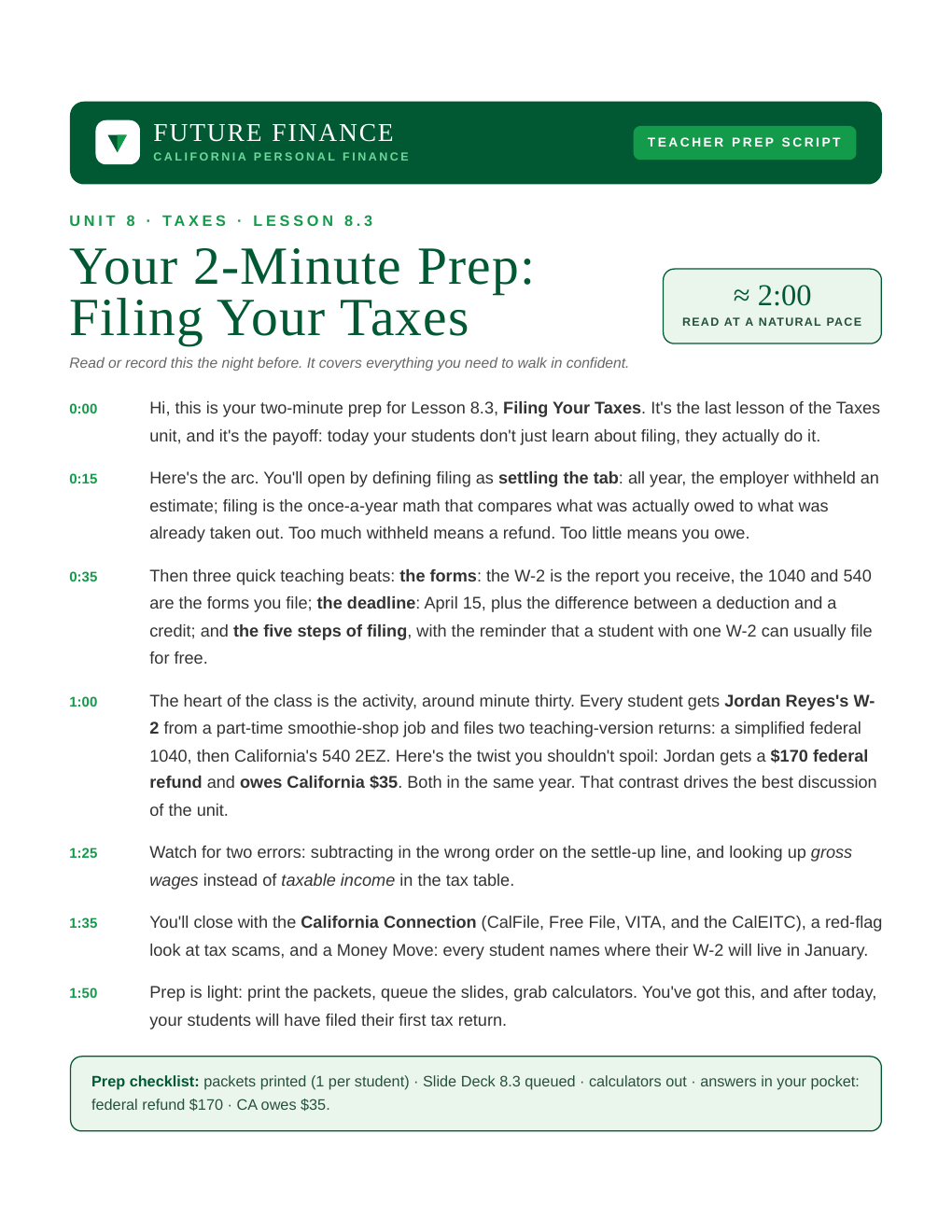
Sample Lesson · 8.3
Filing Your Taxes
Taxes1 Class PeriodAB 2927 Topic 7
Before class
In class
After class

WHAT'S INCLUDED

EVERYTHING'S INCLUDED.
READY TO TEACH ON DAY ONE.

The sample lesson above is not a highlight reel. We deliver every lesson in the semester that complete, and we equip the units and the semester around them, so your teachers spend their time teaching, not assembling.

Every lesson
✓2-minute teacher prep video. Watch it the night before, walk in ready
✓Lesson plan with pacing
✓Slide deck with speaker notes
✓Student activity packet with a real-world "do it"
✓Exit ticket
✓Grading sheet, answer key, and rubric
✓Sub-ready: any lesson can run with a substitute
✓California-specific examples in every lesson
Every unit
✓Unit exam with answer key
✓Unit answer key across all packets
✓Optional extension projects
✓Statutory topic mapping, so your district can show exactly where each required topic is covered
The semester
✓District-ready syllabus
✓Diagnostic exam in week 1
✓Capstone: My Financial Life Plan
✓Final exam
✓Pacing for traditional, modified, and full block schedules
✓Ongoing updates as California laws, rates, and forms change

WHY WE'RE DIFFERENT

OTHER CURRICULA ARE NATIONAL.
WE'RE THE CALIFORNIA COURSE.

There are excellent national personal finance curricula. But "customizable" is another word for decisions, and California's requirement is unusually specific: the course must contain all of, and only, the state's 13 topics. We're the California course itself. We deliver it sequenced, paced, and built on California examples, and we keep it current.

"I've taught from the national materials. They're good. But every Sunday I was still deciding what to cut, what to add for California, and whether it counted. That's the work Future Finance does for your teachers."

Steve Markey · Founder, Future Finance
With a national curriculum, your teacher still decides
•What to teach, what to skip, and in what order. "Customizable" means decisions.
•Whether the result actually satisfies California's 13 required topics.
•What California material to add: Cal Grant, CalKIDS, state taxes, state wages.
•How to make national lessons fit a 90-minute block, or a 55-minute period.
•What needs updating this year, in their own copies.
•Whether the course looks the same in room 12 as it does across town.
Multiply that by every teacher, every semester.
With Future Finance, those decisions are already made
✓Built around California's requirement from day one. Every required topic, sequenced and paced, nothing to verify or supplement.
✓California material embedded, not added: state taxes and forms, Cal Grant, real California wages and rents.
✓Delivered to fit your bell schedule, traditional, modified block, or full block. Every class period is one coherent lesson with a beginning, middle, and end.
✓One consistent lesson architecture, every day: prep video, plan, slides, packet, grading sheet, rubric.
✓When tax brackets, forms, or state rules change, we update the course centrally. Not a thousand teachers' copies.
✓Every student gets the same semester, whichever teacher or campus they land with.
✓We train and support your teachers: district PD to launch, ongoing virtual support, and lesson-level prep guidance all semester.
✓Taught and refined in a California classroom, and teachable by one who has never taught finance.
Open Monday morning. Teach Monday's lesson. Everything is there.
And then Tuesday. And then Wednesday. For the entire California semester, with every class period designed as one coherent lesson: what is direct instruction, what is activity, what is discussion, already decided.

THE REAL COST

FUTURE FINANCE HAS A COST.
FREE CURRICULUM DOES TOO.

Both options cost your district something. One is paid in money. The other is paid in teacher time, and that is the more expensive of the two.

The free option
$0 up front
Paid in teacher time

Tens to hundreds of hours per teacher spent choosing, sequencing, adapting to California, filling gaps in incomplete lessons, and building their own materials. Then keeping all of it current, every year, in every classroom.

Future Finance
Simple per-student pricing
Paid once, per student

Your course arrives complete, California-built, and sequenced, and we keep it current for you. When state rates, forms, or laws change, we update the lessons. Teacher time goes to teaching.

Don't just compare the cost of the curriculum. Compare the cost of the work it requires.

AB 2927, IN PLAIN ENGLISH

WHAT THE BILL ACTUALLY SAYS.

The bill is unusually specific about what must be taught, and deliberately silent on how to deliver it. Every open question below lands on your district. Here is each one, and how we answer it.

What the bill requires
✓A one-semester, stand-alone personal finance course
✓Required for all students
✓13 defined financial literacy topic areas
✓Statewide implementation beginning Fall 2027
✓A graduation requirement starting with the class of 2030-31
Two dates to know
FALL 2027Every high school must offer the course
2030-31The first graduating class that must pass it
What it does not prescribe, and how we answer it
?Which curriculum should districts use?
We hand you a complete California course, so there is nothing to assemble, verify, or supplement.
?Which teachers can deliver it?
Any teacher. Most will get a single PD day before a brand-new class, and we built the course for exactly that: with the daily prep video and fully built materials, a teacher can walk in with next to no training and be completely prepared to teach.
?How are assessments structured?
We build them in: a week-1 diagnostic, unit exams, a capstone, and a final, all with answer keys and rubrics.
?What technology platforms are required?
None. We deliver the course in Google Classroom and Canvas, in the formats your schools already use.
?How is professional development provided?
We provide district PD to launch, ongoing virtual support, and lesson-level prep guidance all semester.
The bill hands every one of those questions to your district. That is the real work of AB 2927, and the reason we built Future Finance so each already has an answer.

THE TIMELINE

EVERY DISTRICT LAUNCHES AT ONCE.

There is no phased rollout. Districts that decide early onboard their teachers calmly. Districts that wait onboard in a scramble.

NOW
Explore
Identify stakeholders, review the 13 topics, and see solutions like this one.
2026 & 27
Decide
Working groups evaluate curriculum, assess staffing, and finalize by spring 2027.
SUMMER '27
Onboard
Teachers assigned and trained, the course scheduled and rostered.
FALL 2027
Launch
Statewide start. The class of 2030-31 is the first that must pass to graduate.

FULL COVERAGE

ALL 13 REQUIRED TOPICS.
NOTHING LEFT TO FILL IN.

California's graduation requirement names the topics your course must contain. We cover every one in full. Here is what each asks of your course.

01
Banking Fundamentals
Savings and checking for personal use, and managing accounts to minimize fees.
02
Budgeting
Principles of budgeting for independent living: a spending plan for life on your own.
03
Employment & Net Income
What a paycheck really pays after taxes and deductions, and your rights as a young worker.
04
Credit
Uses and effects of credit, managing credit scores, and how debt and interest relate to credit.
05
Loans
Uses and costs of loans, including student loans and the policies that provide loan forgiveness.
06
Insurance
Types and costs of insurance: home, auto, health, and life.
07
Taxes
How the tax system impacts personal income, the process to file, and how to read tax forms and pay stubs.
08
Investing & Building Wealth
Tax-advantaged accounts like 401(k)s, pensions, and IRAs, plus stocks, bonds, mutual funds, and index funds.
09
Consumer Protection
Recognizing common scams and frauds, and preventing identity theft.
10
Financing College & Career
Paying for college, workforce education, community college, and apprenticeships: scholarships, merit aid, and student loans.
11
Psychology of Money
How psychology impacts financial well-being: the behaviors behind good and bad money decisions.
12
Charitable Giving
Giving as part of a financial life: how, when, and why to give.
13
Directly Relevant Topics
Other topics directly and specifically relevant to personal finance. This is where California-specific realities like housing costs and state programs live.

CALIFORNIA-FIRST

BUILT FROM CALIFORNIA,
NOT ADAPTED TO IT.

Every unit runs on the taxes your students' paychecks actually show and the colleges they actually apply to. When a student asks "is this how it works here?", the answer is yes.

Taxes & the State Code
Students file a California 540 2EZ alongside the federal 1040, work with real California brackets and withholding, and learn CalFile, VITA, and the CalEITC.
Paychecks
Pay stubs include California SDI, the line national materials skip, and the wage math reflects California minimums, not a national average.
College & Aid
Cal Grant, the California Dream Act, CalKIDS, and the Middle Class Scholarship, with financing lessons run on real UC, CSU, and community college numbers.
Housing & Consumer Protection
California rents, California tenant rights, and California's DFPI.
The California Economy
Scenarios are priced to where students actually live: real California wages, rents, and costs of living, so the lessons match the economy outside the classroom window. And when state rates, forms, or laws change, we update the lessons with them.

WHAT HAPPENS NEXT

THREE STEPS TO FALL 2027.

1
See it for yourself

Explore the complete sample lesson above: every document a teacher would actually use, open right now on this site.

2
Talk to Steve

A conversation about your bell schedule, your timeline, teacher training, and your board's questions, including A-G submission and materials for your adoption process.

3
Pilot it before the deadline

Run the course with one class or one school a full year before fall 2027, so when the requirement lands, your district has already taught it.

ABOUT THE FOUNDER

BUILT IN A CLASSROOM,
NOT A BOARDROOM.

Steve Markey teaches personal finance at San Ramon Valley High School in Danville. Every Future Finance lesson has been taught to real California students and refined over years of semesters, kept relevant to the money decisions they actually face.

That is the curriculum your teachers get: not designed by a committee or a publisher, but proven in the same kind of classroom your students sit in.

Talk to Steve
BUILT IN CALIFORNIA.
BUILT BY A CALIFORNIA TEACHER.
BUILT FOR CALIFORNIA SCHOOLS.
Not adapted to California, built for it
Real classroom usability, not theory
Works for any teacher, any background
Simple per-student pricing, no per-teacher licensing

GET STARTED

GET READY FOR FALL 2027.

Leave your details and Steve will follow up personally. No pitch decks, just a conversation about your district's timeline.

Or write Steve directly: steve@futurefinance.net